
Acupuncture for Anxiety: What the Science Says (and What to Expect at Your First Visit)
Anxiety Is Everywhere in South Florida — and Conventional Treatments Don't Work for Everyone
If you live in Boca Raton or anywhere in Palm Beach or Broward County, you already know: the pace of life here is relentless. Between demanding careers, family pressures, financial stress, and the ever-present noise of modern life, it's no surprise that anxiety has become one of the most common reasons people walk through our door at Acupuncture Xperts.
Anxiety disorders are the most prevalent mental health condition in the United States, affecting tens of millions of adults. Many people manage with therapy, medication, or both — and those tools absolutely have their place. But a growing number of patients are looking for something that complements or, in milder cases, stands on its own: a natural, whole-body approach that addresses the physical experience of anxiety, not just the mental one.
Acupuncture is that approach for a lot of people. And the science behind it is more substantial than you might expect.
How Acupuncture Calms the Anxious Body and Brain
To understand why acupuncture helps with anxiety, it helps to understand what anxiety actually does to your body. When you're chronically stressed or anxious, your body's hypothalamic-pituitary-adrenal (HPA) axis — essentially your stress-response command center — stays activated. That means elevated cortisol, a racing heart, shallow breathing, muscle tension, and disrupted sleep. You're stuck in "fight or flight" long after the threat has passed.
Acupuncture works on several of these mechanisms at once:
- Cortisol regulation: Research from Georgetown University published in the Journal of Endocrinology demonstrated that acupuncture — specifically electro-acupuncture — blocked stress-induced elevations in HPA hormones and NPY, a peptide closely linked to the fight-or-flight response. In plain terms: acupuncture helped dial down the body's stress alarm.
- Endorphin release: Acupuncture stimulates the release of the body's natural feel-good endorphins, which in turn can bring cortisol levels down and promote a lasting sense of calm.
- Nervous system shift: Clinical observations consistently show that acupuncture helps shift the body from sympathetic (fight-or-flight) dominance toward parasympathetic (rest-and-digest) activity — the state where healing, digestion, and deep relaxation happen.
- Neurotransmitter balance: Emerging research suggests acupuncture may help modulate neurotransmitter activity in the central nervous system, including serotonin and dopamine pathways that play a central role in mood regulation.
From a Traditional Chinese Medicine (TCM) perspective, anxiety is often understood as a disturbance of the Heart and Liver organ systems — excess heat, stagnant Qi, or a deficiency of Yin that leaves the spirit (Shen) unsettled. While this framing sounds very different from Western neuroscience, the clinical outcomes often rhyme: when the treatment is right, patients feel calmer, sleep better, and find it easier to think clearly.
What the Research Actually Shows
The evidence base for acupuncture and anxiety has grown substantially over the past decade. Here's a fair, honest summary of where the science stands:
A 2025 systematic review and meta-analysis published in the Journal of Clinical Psychology synthesized randomized controlled trials (RCTs) comparing manual acupuncture against sham acupuncture, usual care, or waitlist controls — with anxiety as the primary outcome. The findings supported acupuncture's efficacy in reducing anxiety symptoms across multiple validated measures.
A separate 2024 systematic review found that acupuncture consistently outperformed placebo on the Hamilton Anxiety Rating Scale (HAMA) and also outperformed first-line medications in certain populations studied — though researchers noted the quality of evidence varied and called for more large-scale trials to confirm findings.
Another area of active research involves generalized anxiety disorder (GAD). Studies note that acupuncture has the advantages of clinical efficacy, a strong safety profile, very few adverse reactions, and — crucially — no risk of dependence, which makes it an attractive option for people who are wary of long-term medication use.
The honest caveat: the research is promising but not yet definitive. Study designs vary, sample sizes are often small, and "sham" acupuncture is notoriously difficult to control for (even placebo needling appears to have some effect). What we can say is that the evidence consistently trends positive, the safety profile is excellent, and the patient experience — in our clinic and in published patient reports — is often meaningfully beneficial.
What Acupuncture for Anxiety Feels Like: A Typical Visit at Acupuncture Xperts
If you've never tried acupuncture, the idea of needles for anxiety might sound counterintuitive. Here's what actually happens during a visit with Dr. Matthew Winke, DACM, at our Boca Raton clinic:
Your First Visit (75 Minutes)
New patients begin with a thorough intake — not just "where does it hurt?" but a conversation about your sleep, digestion, emotional patterns, energy levels, and stress. In Chinese medicine, these aren't separate issues; they're all part of one picture. Dr. Winke will look at your tongue, feel your pulse at both wrists, and ask about your lifestyle before designing a treatment plan that's specific to you.
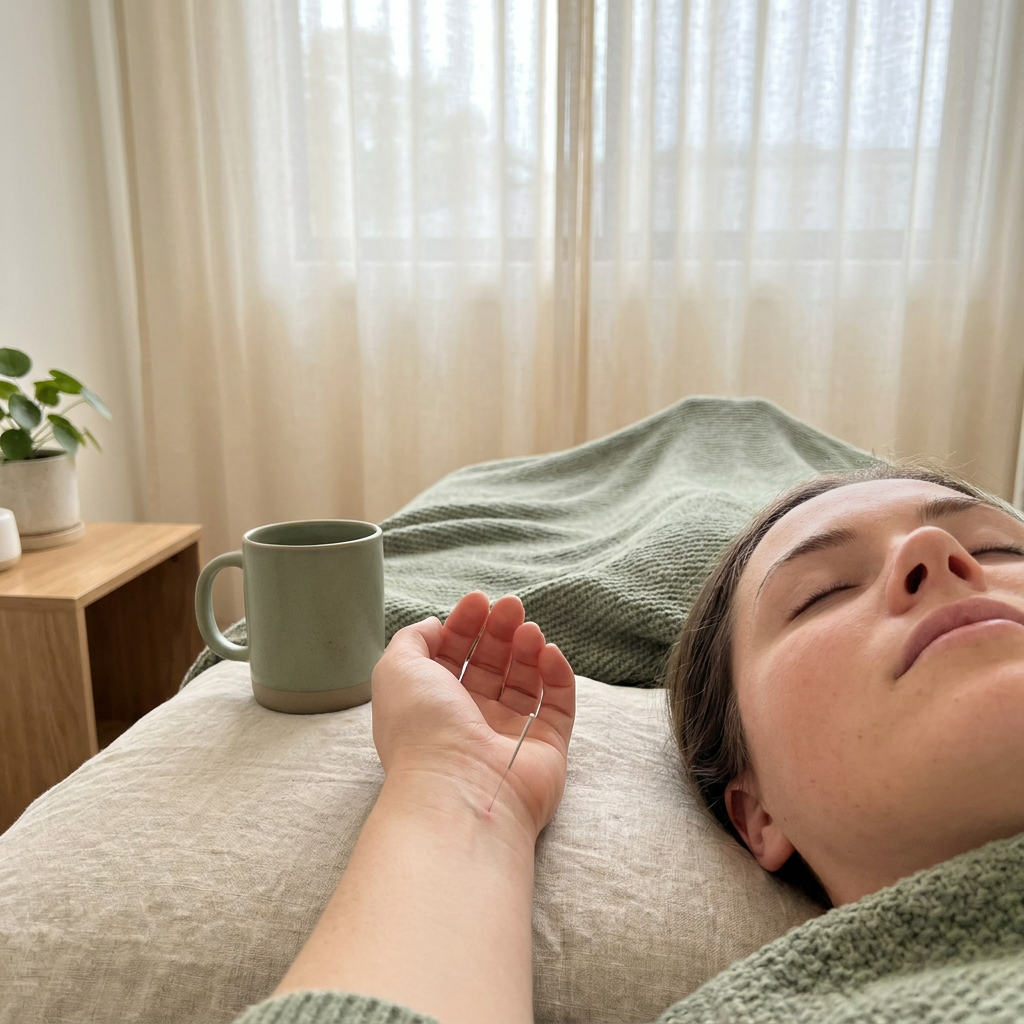
The needles themselves are hair-thin — nothing like a hypodermic needle — and most patients feel little to nothing as they're placed. Common sensations include a mild ache, warmth, or heaviness around the needle site, which TCM practitioners call "de qi" — the sign that the point has been activated. Once the needles are in, you rest quietly for 25–35 minutes.
Most patients describe the experience as deeply relaxing — often more so than they expected. It's common to drift into a light sleep on the table. When the needles come out, many people describe feeling a noticeable shift: lighter, quieter in the mind, less tense in the body.
What Comes After: The Treatment Arc
One session can feel significant. But anxiety — especially chronic anxiety — is rarely resolved in a single visit. Think of acupuncture the way you'd think of exercise or therapy: the benefits compound over time. For most anxiety presentations, Dr. Winke typically recommends:
- Weekly sessions for the first 4–6 weeks to build a foundation
- Bi-weekly visits as symptoms stabilize
- Monthly maintenance once you've reached a comfortable baseline
Patients who commit to a course of treatment consistently report better sleep, reduced physical tension, lower baseline reactivity, and a greater sense of resilience when stressors arise. Our package options make it easy to commit without the friction of booking and paying for each individual session.
Who Is a Good Candidate?
Acupuncture for anxiety works well for a broad range of people. You may find it especially helpful if:
- You experience generalized anxiety, social anxiety, or situational stress that disrupts daily life
- Your anxiety shows up physically — as insomnia, muscle tension, digestive upset, or a racing heart
- You've tried medication but experienced side effects or want to reduce your dose (always in coordination with your prescribing physician)
- You're currently in therapy and want a complementary somatic approach that helps regulate your nervous system between sessions
- You prefer a natural, drug-free option and are open to a treatment course
Acupuncture is not a substitute for psychiatric care, and Dr. Winke will never encourage you to stop or alter a medication without your physician's guidance. What acupuncture can do is provide a powerful, evidence-informed complement — addressing the physical landscape of anxiety in a way that talk therapy and medication alone often cannot.
Why Choose Acupuncture Xperts in Boca Raton?
Dr. Matthew Winke holds a Doctor of Acupuncture and Chinese Medicine (DACM), is a Florida-licensed acupuncturist, and completed additional clinical training in Beijing, China. He brings that depth of training to every condition he treats, including anxiety and stress.
Our clinic is a calm, unhurried, one-practitioner practice — not a volume-driven wellness chain. Every patient sees Dr. Winke directly. Every treatment plan is individualized. The environment itself — quiet, carefully designed, with soft light and intentional detail — is part of the therapy.
We're located in East Boca Raton, near I-95 and Yamato Road, with easy parking at the One Park Place building. We serve patients from across Palm Beach and Broward Counties, including Delray Beach, Boynton Beach, Deerfield Beach, Coral Springs, and Parkland.
Ready to Try It? Here's How to Get Started
Your first step is a New Patient Visit: 75 minutes with Dr. Winke for $189. That includes a full intake, a custom treatment plan, and your first full acupuncture session.
If you're ready to commit to a course of treatment, our package options offer 5, 10, or 15 total visits — a meaningful investment in a calmer, more grounded version of your daily life.
Booking is easy and available online 24/7. Same-day appointments are sometimes available, so if today is the day you're ready to do something about anxiety, check what's open.
Book your first visit online or call us at (561) 709-6512. We're here — and so is a quieter version of your nervous system.