
When Massage Isn't Enough: What Gua Sha Feels Like
There is a particular kind of tightness that stretching never quite reaches. You roll your shoulders, you get a massage, you feel better for an evening — and by the next afternoon the same band in your neck or along your upper back has clocked back in.
That is the moment many people start looking up gua sha. They see photos of a smooth tool, they hear “scraping massage,” and they want a straight answer: what is this, what does it feel like, and is it worth booking?
At Acupuncture Xperts in Boca Raton, gua sha is clinical bodywork, not a spa add-on. Dr. Matthew Winke, DACM, uses a smooth-edged tool on areas of tension — most often the back, neck, and shoulders — to support circulation and help restricted tissue release. You can book it as a needle-free visit.
The feeling people are actually asking about
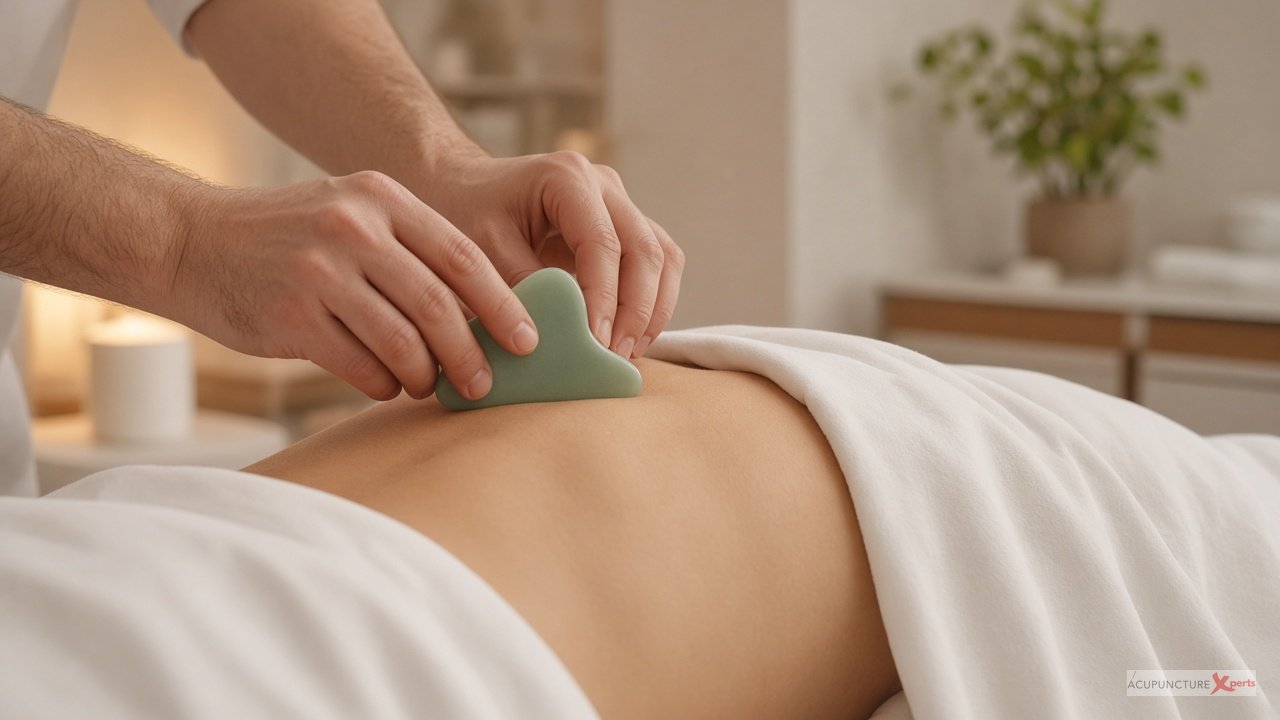
Gua sha means “scraping sand.” The name sounds rougher than the technique. The tool has a smooth edge. It is stroked repeatedly over a tight region with steady, controlled pressure.
It does not feel like someone is casually rubbing lotion into your back. It feels more like specific work along a rope of tissue that has been braced for too long. The pressure should stay in a range you can breathe through. If it crosses into “too much,” you say so, and the work adjusts. Purposeful is useful. Reckless is not.
Because the strokes stay on a focused area, people often notice that the visit is less general than a full-body massage and more like going after the spot that has been running the show.
Why this is not the same thing as a regular massage
Massage uses hands and bodyweight. Gua sha uses a smooth-edged tool to work along restricted tissue. That is the mechanical difference, and it is why the two are not interchangeable labels.
It is also why they can belong in the same appointment. At Acupuncture Xperts, gua sha is booked as a Bodywork visit. After a brief review, treatment may include gua sha (muscle scraping), neuromuscular massage, manual therapy, or a mix of those. If you want hands-on care without acupuncture, this is the visit designed for that.
So if you have been trying to decide between “just get a massage” and “try that scraping thing,” you do not have to treat them as rivals. The session can use massage where broader work helps and gua sha where a stubborn band of tension needs a more specific edge.
A different method from cupping
Cupping is often mentioned in the same breath because both come from traditional practice and both are used when tissue feels stuck. They are still different methods. Cupping relies on cups and suction. Gua sha relies on strokes with a tool.
If cupping is the technique you have been reading about, start with the clinic’s cupping page. If the question in your mind is about scraping, gua sha is the match.
Where gua sha tends to help
In practice, gua sha is used as focused bodywork for tight, restricted areas and more comfortable movement. It is often considered for:
- Neck and back tension that keeps returning
- Shoulder and upper-back tightness
- Overuse and sports-related muscle restriction
- Areas of scar tissue that feel bound down
Some people also come in with related complaints such as sciatica or tendon irritation, when tight surrounding tissue is part of what they feel. Circulation in the surface tissues may change in the short term — small studies have observed that after gua sha — and many patients are really hoping for something simpler: the area moves more easily and does not seize back up the moment they sit down again.
That hope is reasonable. A guarantee would not be. Bodies differ, and a long-standing pattern usually needs more than one kind of change: good hands-on work, and some honesty about the daily strain that keeps feeding the tightness.
What happens in the room
The visit starts with a conversation, not with the tool. Dr. Winke will ask where the tension lives, what sets it off, and what you want from the session.
You will be draped so only the area being treated is uncovered. The gua sha work itself is a series of strokes over the tight region, usually along the back, neck, or shoulders. Nearby massage or manual therapy may come before or after, depending on what the tissue needs.
The point of the visit is not to chase a number on a pain scale and stop there. Dr. Winke has put the clinic’s aim this way: understand the body deeply enough to change the underlying pattern creating the pain, so it does not keep coming back.
A confident option — with honest limits
Gua sha is a real answer for restricted tissue, not a trend that only works until you walk outside. Used well, it gives tight areas a chance to circulate, release, and move more like themselves again.
It cannot, by itself, undo a workstation that keeps your head jutted forward eight hours a day, or a training plan that never lets a tendon rest. Care works best when the in-office work and your daily load are pointing in the same direction.
If you have already tried stretching and massage and the same tightness is still waiting for you, a Bodywork visit that includes gua sha is a clear next step — practical, needle-free if you want it that way, and aimed at the tissue that has been ignoring gentler approaches.
Book a Bodywork visit
Learn more on the gua sha page at Acupuncture Xperts, then book:
Acupuncture Xperts
Dr. Matthew Winke, DACM
One Park Place, 621 NW 53rd Street, Suite 125
Boca Raton, FL 33487
(561) 709-6512