
Holiday Bloating: Why Big Meals Leave You Heavy, and How Acupuncture Can Help
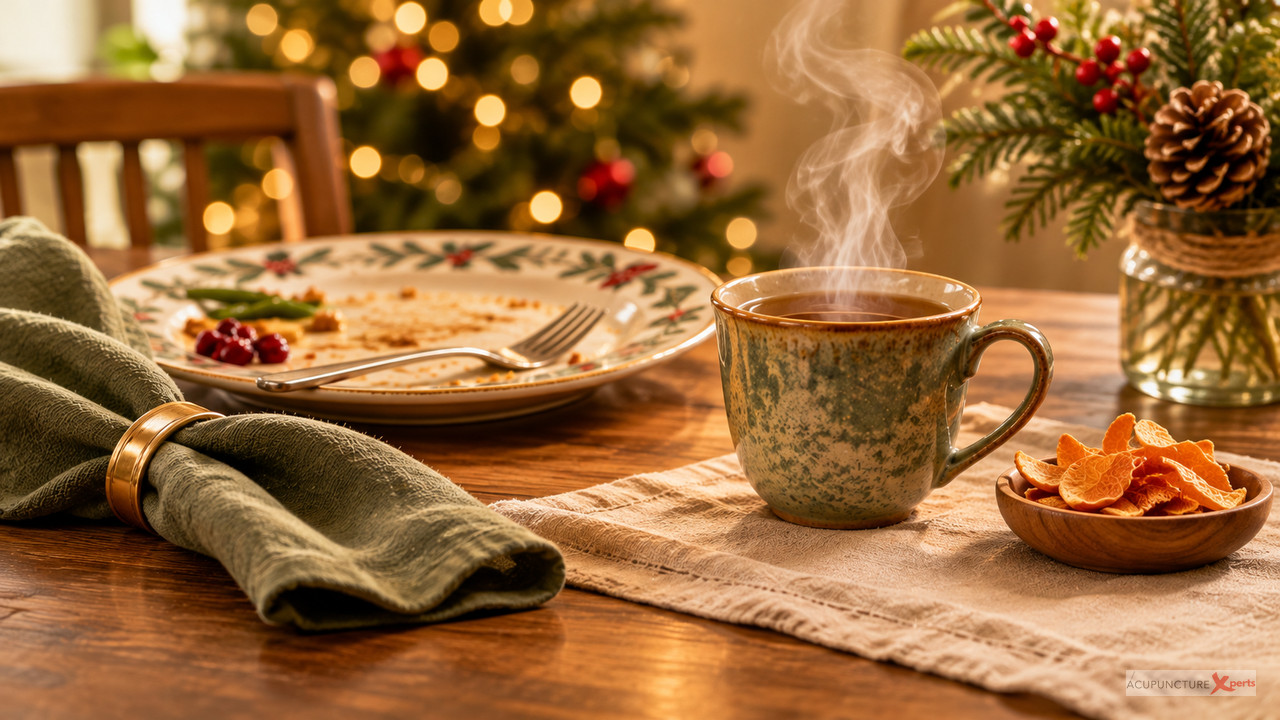
Thanksgiving dinner is wonderful right up until the moment you can't get comfortable on the couch. Your belly feels tight, your waistband feels smaller than it did an hour ago, and the pie you were looking forward to suddenly seems like a bad idea.
Holiday bloating is common, and it usually isn't serious. But if it shows up after every big meal, or keeps hanging around long after the leftovers are gone, it's worth paying attention to. Here's why it happens, what helps at the table, and how acupuncture, nutrition and Chinese herbal medicine can support easier digestion through the holidays and beyond.
Why your belly feels so full
Your gut moves food along in gentle, rhythmic waves. When those waves slow down, food sits longer, and gas and pressure start to build. That's the heavy, stretched feeling most people call bloating.
The holidays stack the deck against those waves:
- Large, rich meals. Big portions and fatty dishes take longer to move through.
- Alcohol and extra coffee. Both are common triggers for gut discomfort.
- Certain fermentable carbs. Foods high in FODMAPs, such as beans, onions, garlic and some breads, can produce more gas in sensitive people.
- Stress. Travel, hosting and packed calendars affect the gut more than most people expect. Stress is one of the most consistent triggers of digestive flares.
Simple ways to ease it at the table
None of these require skipping the party:
- Eat a little slower. Put your fork down between bites and give your stomach time to catch up.
- Choose a smaller first plate. You can always go back.
- Take an easy walk after dinner. A slow lap around the block helps some people settle.
- Notice your personal triggers. If the same dish leaves you uncomfortable every year, that's useful information.
These help some people some of the time. When bloating keeps coming back anyway, it's a sign your digestion may need more support.
Food choices that are kinder to digestion
Chinese medicine has long favored warm, cooked foods when the gut feels overworked. You don't need a special holiday diet. A few practical shifts are often enough:
- Prefer warm and cooked over cold and raw at big meals. A chilled salad or iced drink can feel heavier for some people than the same vegetables cooked, or a warm soup. This is a traditional Spleen-and-Stomach idea, not a rule for every plate.
- Sip something warm after eating. Ginger tea, fennel tea and peppermint tea are common, gentle choices. If peppermint tends to stir up your reflux, skip it and use ginger or fennel instead. A little tangerine or citrus peel — called chen pi in Chinese medicine — is a traditional kitchen addition to tea or cooking, used to help rich food move along.
- Drink warm water through the day, rather than only ice water with the meal.
- Keep portions modest and chew slowly. The smaller first plate above matters here too. Your stomach needs time to keep up.
- Go easier on greasy dishes, sugary desserts and alcohol. They're common bloating triggers, especially when they show up together.
- Notice your fermentable carbs. If beans, onions, garlic or certain breads leave you gassy every year, that's the FODMAP pattern mentioned earlier. You don't have to cut them all out; a smaller serving of your usual triggers is often enough.
These are general habits, not a prescription. If you have a medical condition or follow a special diet, check with your physician before making big changes.
How acupuncture supports digestion
In Chinese medicine, digestion is traditionally tied to the Spleen and Stomach, the systems responsible for turning food into energy. When they're overworked, the traditional picture looks a lot like the holidays: heaviness after meals, gas, low energy and a belly that never quite feels settled. It's a traditional way of looking at the body, not a lab test, but it gives us a practical map for treatment.
Modern research is encouraging, too. A 2020 randomized trial published in the Annals of Internal Medicine followed 278 adults with functional dyspepsia, a common condition marked by post-meal fullness, upper-belly bloating and filling up quickly. After 12 acupuncture sessions over four weeks, 83% of patients responded, compared with 52% in the sham group, and the benefit held up through 12 weeks of follow-up with no serious side effects (read the study). It was one well-designed trial, measured by self-reported symptoms and done in China, so it isn't a promise for every person. But it's a strong sign that a focused course of care can bring lasting relief, not just a quick fix.
Chinese herbal medicine for that stuck, too-full feeling
When food sits too long, Chinese medicine often calls the pattern food stagnation: fullness, bloating, and a heavy feeling that doesn't pass as quickly as you'd like. Classic herbal formulas are sometimes used in that picture. They're chosen to match the person, not just the meal.
A few well-known examples:
- Bao He Wan (Preserve Harmony Pill) is the traditional formula most often linked to food stagnation after overeating — that heavy, stuck feeling after a rich meal.
- Si Jun Zi Tang (Four Gentlemen Decoction) and Liu Jun Zi Tang (Six Gentlemen Decoction) are used when digestion feels weak rather than simply overloaded: bloating with low appetite, low energy, or a belly that feels full after ordinary meals. Xiang Sha Liu Jun Zi Tang is a related formula used when that weakness comes with more fullness, gas or a stuck feeling after food.
- Ban Xia Xie Xin Tang is traditionally used for a focal, uncomfortable fullness in the upper belly, sometimes with mixed symptoms such as a little nausea or uneven digestion.
These names are a map of the tradition, not a shopping list. Chinese herbal formulas should be chosen by a licensed practitioner after an evaluation. They are not a substitute for medical care, and they are not something to self-prescribe. If you are pregnant, nursing or taking medications — including blood thinners — check with your physician first. Herbs can interact with other drugs, and the right formula for one person can be a poor fit for another.
During a visit at Acupuncture Xperts, Dr. Winke can recommend nutrition guidance and herbal formulas when they fit your picture, alongside acupuncture.
What a visit looks like
At Acupuncture Xperts, Dr. Matthew Winke, DACM, starts by asking how your digestion behaves day to day: when bloating shows up, what makes it better or worse, and how stress and sleep fit in. Your treatment is built around that pattern, so it's tailored to you rather than a one-size-fits-all protocol. If nutrition support or an herbal formula would help, that can be part of the same visit.
If bloating is part of a bigger picture, you can learn more on our pages for IBS, constipation and acid reflux, or read more about acupuncture at our clinic.
When to see your doctor first
Bloating after a big meal is normal. Some symptoms are not. Check with your physician if you notice blood or black stools, unexplained weight loss, symptoms that wake you at night, new bowel changes after age 50, severe or worsening pain, trouble swallowing, or vomiting. Acupuncture works well alongside your medical care, not in place of a proper evaluation.
Enjoy the season, comfortably
The holidays are for good food and good company, not for loosening your belt by 3 p.m. If bloating keeps coming back, we'd be glad to help you feel lighter and more comfortable this season.
New patients: Book your first visit
Returning patients: Book Signature Acupuncture
Or call us at (561) 709-6512.
Live Pain Free.
See It in Action
Short videos from our Instagram, @acupuncturexperts on Instagram (opens in a new tab).
Acupressure point for digestion and energy: ST36.
View on Instagram (opens in a new tab)
