
When the Air Turns Dry: A Florida Acupuncturist on Fall, the Lungs, and Letting Go
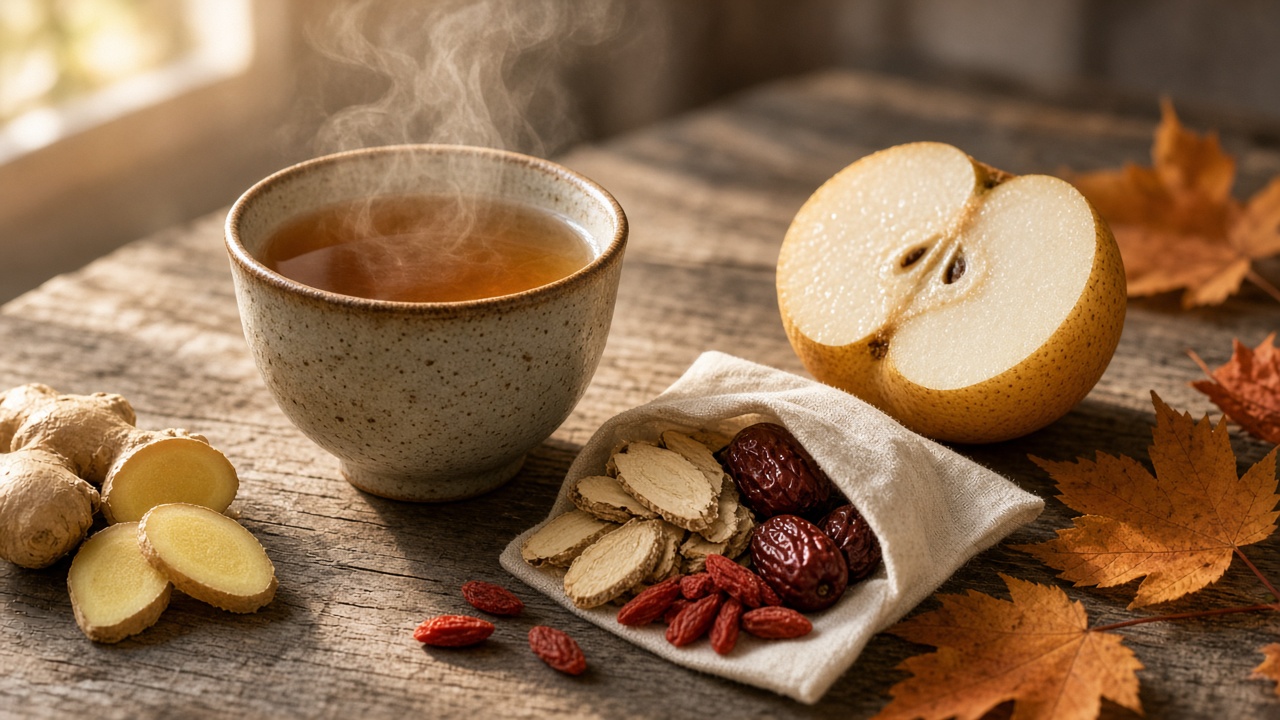
Every October, someone in my practice says a version of the same thing: "It doesn't really feel like fall here." And they're right, at least on the surface. In Boca Raton we don't get blazing maples or frost on the windshield. The palms stay green. The pool is still warm.
But if you pay attention, the season does turn. The light comes in lower and softer in the late afternoon. The mornings carry a little less weight in the air. Sunset arrives before dinner. And in my practice I start to notice a pattern of its own: more dry throats, more stuffy sinuses, more people telling me they feel a bit tired or a bit heavy-hearted without knowing why.
Traditional Chinese Medicine has a way of describing this shift that I've always found both practical and beautiful. I'd like to share it with you, along with a few things you can do at home.
The season of Metal
In TCM theory, each season is linked with one of five elements. Fall belongs to Metal. Metal is the element of refinement and clarity, of keeping what is valuable and releasing what is not. Think of a harvest: the work of summer is gathered in, and what's left goes back to the earth.
Metal is paired with two organ systems, the Lung and the Large Intestine. In the traditional view, the Lung takes in what is fresh and new with every breath, and the Large Intestine lets go of what is no longer needed. Taking in and letting go. That rhythm is the heart of this season.
Fall is also the point in the year when things start turning toward yin. Summer is yang: bright, outward, active, long days. Yin is the quieter half: rest, coolness, inward attention, nourishment. As the days shorten, TCM suggests we follow nature's lead and begin to gather our energy in rather than spend it all outward.
Dryness, and why the Lung minds it
Each season also has a climate it is associated with, and for fall that is dryness. In TCM theory, the Lung is described as a "delicate" organ that prefers a little moisture. When dryness takes hold, the traditional view holds that it often shows up first in the places the Lung governs: the skin, the nose and sinuses, and the throat.
You may recognize some of these: skin that feels tight after a shower, a scratchy throat when you wake up, nasal passages that feel raw, a dry tickle of a cough. In TCM the Lung is also tied to wei qi, often translated as "protective qi," a kind of outer layer of resilience at the surface of the body. In Western medicine, this could be seen as the immune system. Traditional theory says that when the Lung is well supported, this protective layer can do its job more comfortably.
Here's the Florida twist. Our outdoor air is rarely dry. But many of us spend most of the day indoors, under air-conditioning that runs from morning to night and pulls moisture out of the air. Go from a humid parking lot into a chilled, dry office and back again a few times a day, and that is its own kind of seasonal stress. Add fall allergy season, when ragweed and other pollens are in the air, and it's no surprise that sinuses and throats feel it.
Grief, and the art of letting go
In TCM, every organ system has an emotional resonance. For the Lung, it is grief, and its healthy counterpart is the ability to let go.
I want to touch on this lightly, because it isn't something to over-read. Fall doesn't make anyone sad. But many people do find this season a little more reflective. The year is winding down. The holidays bring up memories of people we miss. In the traditional view, giving yourself room for those feelings, rather than pushing them aside, is part of what keeps the Metal element balanced. Sometimes a long exhale, a walk at dusk, or a good cry is exactly what the season asks of us. If sadness feels heavy or lasts, please reach out to your doctor or a counselor. That is care too.
Eating for the season
Traditional Chinese dietary thinking leans toward warm, cooked, moistening foods in fall. Soups, stews, congee, roasted vegetables and gently cooked grains are easier on digestion, in the TCM view, than large amounts of iced drinks and raw salads.
White foods have a special association with Metal and the Lung. A few I like this time of year:
- Pears, especially poached or baked, are a classic fall food in Chinese households for a dry throat.
- Daikon radish in soups.
- White fungus (snow fungus), often simmered into a light, sweet soup.
- Almonds, rice, and cauliflower.
Nutrients worth knowing about
Food is also where I like people to start when it comes to vitamins and minerals. A few nutrients come up often this time of year.
Vitamin D surprises people in Florida. We live in the Sunshine State, yet many of us spend most daylight hours indoors, in a car, or wearing sunscreen. Vitamin D plays a role in normal immune function, and you can check your level with a simple blood test.
Vitamin C, found in citrus, bell peppers, broccoli and kiwi, and zinc, found in pumpkin seeds, chickpeas and seafood, are both part of how the immune system normally works. Omega-3 fats, from fish like salmon and sardines or from walnuts and flaxseed, may support overall wellness as part of a balanced diet.
The old formulas
Chinese herbal medicine has a long tradition of seasonal formulas, and three come up often in conversations about this time of year. I share them so you understand the tradition, and how they can help you fight off infections.
Yu Ping Feng San, whose name means "Jade Windscreen," is traditionally used to support wei qi, that protective outer layer I mentioned. The image is a folding screen that shields you from the wind.
Yin Qiao San is traditionally used at the very first signs of what TCM calls a wind-heat pattern: a scratchy, sore throat and a slightly feverish feeling.
Gui Zhi Tang is traditionally used for a wind-cold pattern, where someone feels chilled and achy with a mild sweat.
Notice that two of these are used for opposite patterns. That is exactly why herbal formulas aren't one-size-fits-all. They should be chosen with a licensed practitioner who knows your history, and they can interact with medications, and some aren't appropriate during pregnancy or nursing, so your doctor should be in the loop too.
Small rituals for the turn of the season
- Go to bed a little earlier. TCM encourages following the shorter days with more rest. Even 30 minutes can feel like a gift.
- Breathe on purpose. A few minutes a day of slow breathing, with an exhale a little longer than the inhale, is a lovely way to honor the Lung.
- Cover your neck. In the traditional view, the back of the neck is where wind and cold get in. Keep a light scarf for chilly restaurants, offices and movie theaters.
- Humidify. If your AC runs constantly, a humidifier in the bedroom may help with dry air.
- Make room for the holidays. The season gets busy fast. Protect a little quiet each week.
Where acupuncture fits in
In my practice, many people come in during seasonal transitions simply to feel more settled. Acupuncture can support relaxation and help with the stress that tends to build as the holidays approach. Within TCM theory, I choose points to help support the Lung and wei qi and to ease the body through the turn toward yin. It is gentle, and most people find the session itself deeply calming.
If you'd like to come in this fall, you can book online here or call (561) 709-6512. We're at One Park Place, 621 NW 53rd Street, Suite 125, Boca Raton, FL 33487.
Here's to a gentle fall, even a Florida one.
Live Pain Free.